
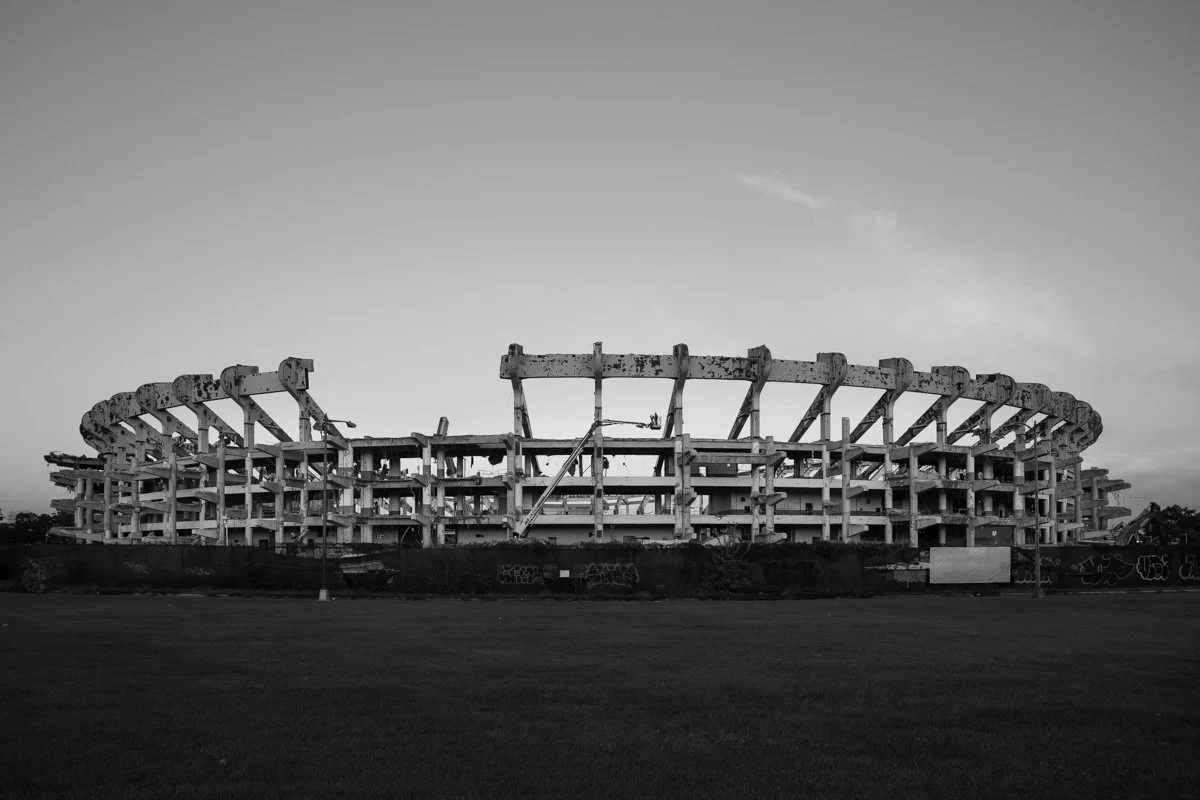
MOST PHOTOGRAPHS OFFER AT LEAST A HINT OF NARRATIVE, but the shows at Multiple Exposures often take a tricky approach to storytelling, spinning episodic tales based purely on visual affinities. That’s not the case with the gallery’s current exhibition, Eric Johnson’s “The Last Days of RFK Stadium.” Presented in strict chronological order, the D.C. photographer’s 22 black-and-white pictures document the 2025-26 disappearance of the structure that debuted in 1961 as D.C. Stadium.
The stark images can be seen as journalistic, tracing the process from the basically intact edifice on January 17, 2025 to an empty, snow-covered lot in the final frame 373 days later. Yet Johnson’s pictures evoke myriad places and things -- a modern Stonehenge under a black, full-moon night; the ribcage of a beached, largely decayed whale; and, almost finally, the ruin of an ancient city.
Viewers needn’t have any personal connection to the vanishing stadium to find some of these photos poignant. The increasingly desolate upright supports reach yearningly for the sky, which seems to expand as the building recedes. As Johnson watches, RFK shrinks from a sturdy, self-contained hulk to a spindly frame for the firmament above it.
THE SKY IS ALSO AMONG THE SUBJECTS of Photoworks’s “Dis/Orientation,” but Scott Davis’s black-and-white pictures, unlike Johnson’s, are not grounded. The billowing shapes lack an identifiable vantage point and thus are gently dizzying. Davis, also a D.C. photographer, was inspired by East Asian screen paintings and Alfred Steiglitz’s pioneering 1925-34 abstract cloud photos, according to a gallery note.
While Davis’s 10 cloud studies can appear vast, the exhibition’s other 35 pictures are tiny closeups that sit quietly inside wooden frames. Some of the objects depicted in the smaller photos are recognizable, if occasionally oriented in eccentric ways. But these pictures aren’t concerned with representation. Davis’s cups, bottles, and leaves may not look as cosmic as his clouds, but both sets of photos are exercises in light, shadow, and insubstantiality. Glimpsed through Davis’s lens, glass and metal become as airy as water vapor.
Review of Eric Johson’s Solo Show by Mark Jenkins from Discerning Eye
Previous
Previous
CITYPAPER EXHIBIT REVIEW: Alan Sislen’s “AMBIGUITY” by Louis Jacobson
Next
Next